

I have spent much of my career helping turn complex technology into experiences people can understand and trust. Local AI brings that challenge into a very personal place: the computer already sitting on my desk.
Most regular users first experienced generative AI through cloud-based services. They type a question, their words travel to a remote data center, and an answer comes back. A local large language model changes that path. The model is downloaded to my own PC and the work can happen there.
From renting intelligence to keeping it nearby
A local LLM is a language model that runs on my own hardware. I can use it to summarize a report, organize notes, draft ideas, explain a difficult topic, or help with code without depending on a remote service for every request.
I think of it like the difference between streaming a song and keeping a copy on my device. Streaming can give me a vast library and enormous scale. A local copy gives me direct access, more control, and the ability to use it when the connection is unavailable. Neither approach wins every situation.
This is why I do not see local and cloud AI as enemies. The cloud is often the right place for the largest and most capable models. Local AI is compelling when privacy, responsiveness, customization, offline access, or predictable usage matters more.
Privacy depends on the full path
When a model and its supporting tools operate locally, my prompt and source material do not have to leave my machine. That can be valuable when I am working with personal notes, an early product concept, or an internal document.
But I still verify the complete workflow. A local model can be connected to an application that sends analytics, performs web searches, or calls a cloud service. “Local model” does not automatically mean “nothing leaves the PC.” I check the model, the interface, the plug-ins, and every external connection.

Privacy is not a label. It is an engineering property of the entire experience.
The best model is the one that fits
Model names often include a number followed by B, meaning billions of parameters. Parameters are learned numerical values. I think of them as billions of tiny adjustable dials that help the model recognize and produce patterns.
More parameters can bring more capability, but they also need more memory and computing power. A model that barely fits can make the experience painfully slow. A smaller model that answers quickly and reliably may create far more value.
Google’s current Gemma guidance makes a similarly practical recommendation: begin with an instruction-tuned model with the lowest parameter count available, then move up only when a smaller model cannot meet the need.
The memory question matters most. RAM is the computer’s main working space. VRAM is the high-speed working space attached to a graphics processor. I picture both as a workbench: if the project is larger than the bench, I must move pieces back and forth, and everything slows down.
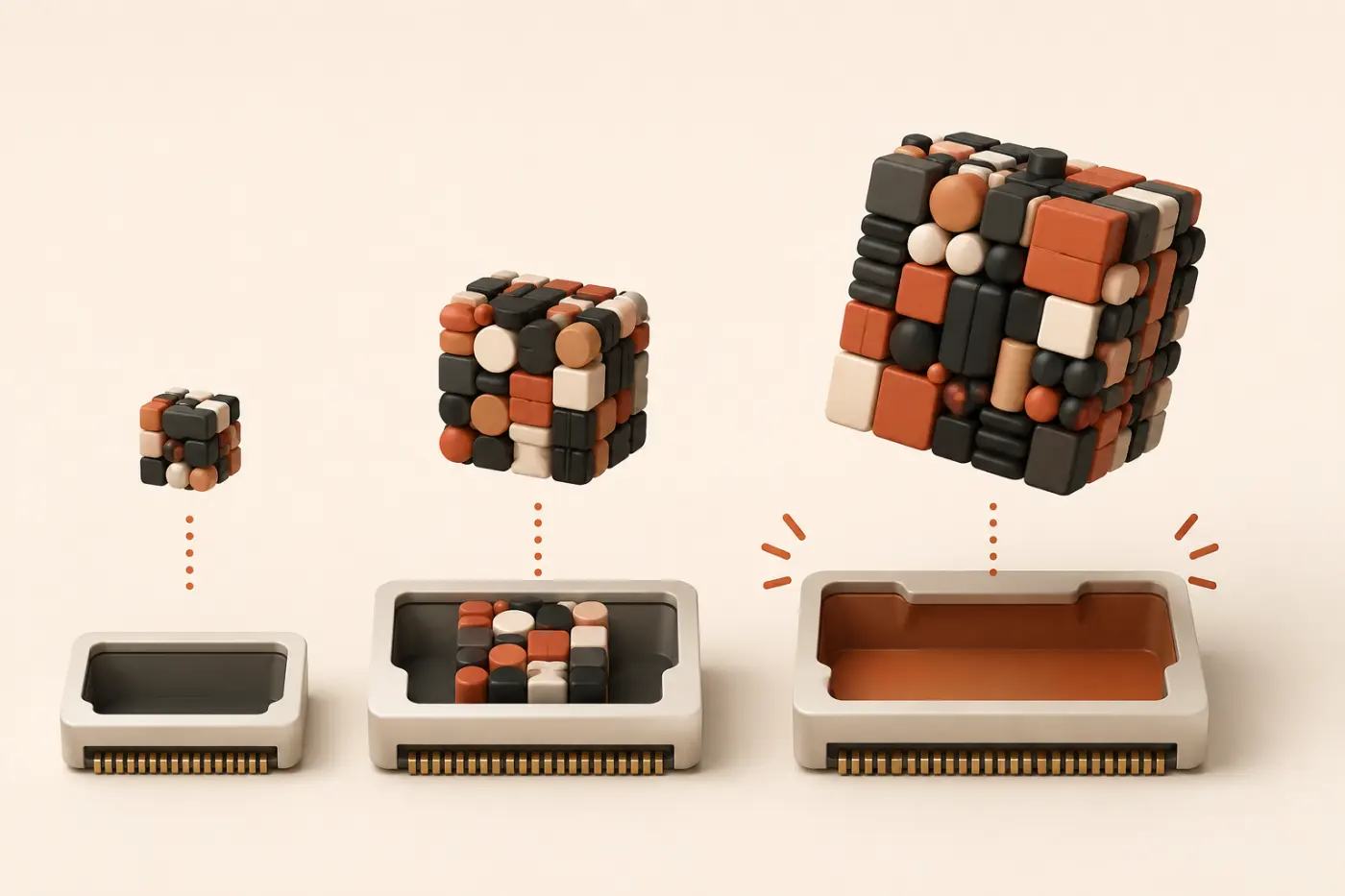
Quantization: fitting more into less
One reason local models have become more accessible is quantization. This means storing parts of the model with lower numerical precision. I think of it like packing a winter coat into a vacuum bag: the same coat takes less room, although the compression can introduce compromises.
Hugging Face documents common 8-bit and 4-bit approaches. Eight-bit loading can roughly halve model memory use, while 4-bit methods compress further. Lower precision can make a model practical on consumer hardware, but it can also affect quality. I test the actual task instead of assuming the smallest file is automatically best.
I begin with the experience
My starting point is not “What is the biggest model I can run?” It is “What do I want this experience to do?”
For private summarization, I test it with documents similar to the ones I will really use. For writing, I look for clarity, tone, and consistency. For an assistant, I measure how long it takes to begin responding and whether it completes the workflow correctly. For factual work, I check its answer against trusted sources because local models can be confidently wrong just like cloud models.
I also separate inference from training. Inference is using an already trained model to produce an answer—like asking an experienced chef to prepare a meal. Training is creating or substantially teaching the chef, which requires far more data and computing power. Most people exploring local AI are performing inference, not building a foundation model from scratch.
Where it becomes meaningful
The value becomes clear when local intelligence is connected to a real need. I can summarize sensitive material on my PC, create a knowledge assistant around files I control, automate repetitive work without paying for every generated token, work offline, and experiment with open models.
This matters to me: technology becomes valuable only when a person can relate to it. The goal is not to place a complicated model on a device and call it innovation. The goal is to make intelligence feel simple, intuitive, personal, and useful.
Five questions I ask
- Does the information need to stay on the device?
- Will I use the model enough for local ownership to be worthwhile?
- Does my hardware have enough memory for the model and context?
- Is a smaller model accurate enough for this specific job?
- Would a hybrid experience serve me better?
Local AI is not a smaller imitation of cloud AI. It is a different design choice. It gives me a new place to put intelligence: close to my data, under my control, and inside an experience I can shape.
AI is no longer only a service I visit. It is becoming a capability I can own, understand, and place beside me.